Taiwan Air Force Completes T-5 Brave Eagle Trainer Fleet
Taiwan's Aerospace Industrial Development Corp. Delivered the final two T-5 Brave Eagle advanced jet trainers to the Republic of China Air Force on
The T-5 Brave Eagle advanced jet trainer program has reached its conclusion with the delivery of the final two aircraft. Taiwan’s Aerospace Industrial Development Corp. (AIDC) handed over the last two of 66 T-5s to the Republic of China Air Force (ROCAF) on September 24, 2026.
The two aircraft, serial numbers 1165 and 1166, took off from Ching Chuan Kang Air Base in Taichung at 11:00 a.m. Local time. After a circuit and a low pass over AIDC’s Shalu plant, they landed at the Air Force Academy in Gangshan, Kaohsiung, at 11:36 a.m. AIDC Chairman Tsao Chin-ping participated in the delivery flight. "I flew aboard aircraft 1166 alongside a company test pilot," Tsao said. The handover occurred exactly seven years after the first prototype was rolled out on September 24, 2019, an event where then-President Tsai Ing-wen named the aircraft Brave Eagle.
Production Milestones
The program was launched in 2017 under a three-party arrangement between ROCAF, the National Chung-Shan Institute of Science and Technology (NCSIST), and AIDC. The manufacturer states the trainer went from design to first flight in three years and two months. The prototype first flew in June 2020, and series production began the following year.
Production faced significant challenges. Shortages of imported systems and components occurred during the COVID-19 pandemic and subsequent geopolitical disruption. In response, AIDC brought production of several hard-to-source parts in-house and collaborated with NCSIST, the Industrial Technology Research Institute (ITRI), the Automotive Research & Testing Center (ARTC), and domestic suppliers. AIDC President Chuang Hsiu-mei noted the final push involved delivering 14 aircraft in 2025 and another 14 in 2026 to complete the run.
| Milestone | Date |
|---|---|
| Program Launch | 2017 |
| Prototype Rollout & Naming | September 24, 2019 |
| First Flight | June 2020 |
| Start of Series Production | 2021 |
| Public Display at Chihhang Air Base | July 2022 |
| Final Delivery | September 24, 2026 |
Operational Transition
The T-5 replaces two aging types in the training syllabus: the AT-3 Tzu Chung advanced trainer, retired at the end of July after over 40 years of service, and the F-5E/F fighter, which has stopped being used for operational training. This change allows ROCAF to reorganize pilot instruction into a three-stage, two-aircraft system. The T-5 now covers both advanced and lead-in fighter training before students transition to frontline fighters. Some cadets have already transitioned directly from the basic T-34C trainer to the Brave Eagle, bypassing an intermediate stage.
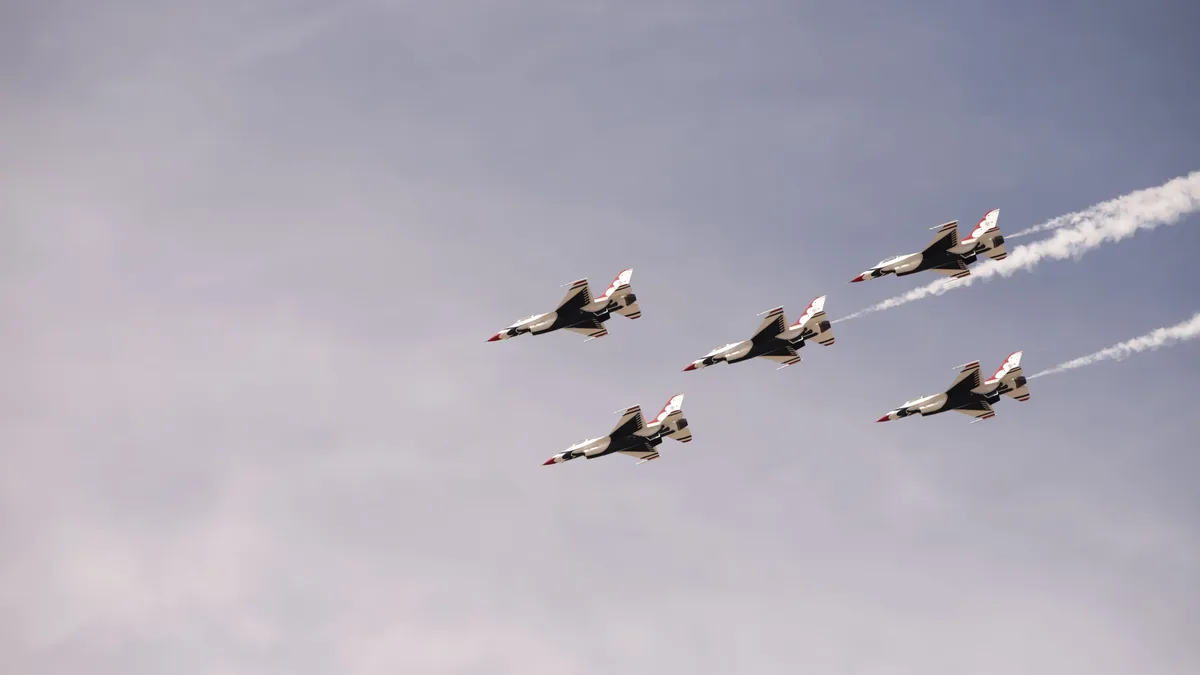
The aircraft are primarily stationed at the Flight Training Command at Gangshan Air Base and at Chihhang Air Base in Taitung County. One aircraft, serial number 1130, was lost in February 2025 following a dual-engine power failure, though the pilot ejected safely. The Thunder Tigers aerobatic team has transitioned to the T-5, with several aircraft modified with colored smoke-generation systems for displays. These aircraft wear the standard red, white, and blue Brave Eagle livery, not a team-specific scheme.
Future Support
With production complete, AIDC’s focus shifts to long-term fleet support. The company will provide maintenance, upgrades, and logistics under a life-cycle support arrangement with the Air Force. Chuang Hsiu-mei estimated that open-ended support contracts for the T-5 and the related F-CK-1 Ching-kuo fighter fleets are worth more than NT$30 billion, approximately $940 million. The design, derived from the F-CK-1 but with over 80% redesign including aerodynamics and airframe details, provides space for armaments. The Air Force plans to use air-to-air and air-to-ground weapons on it, potentially enabling a secondary light attack role in wartime.
Industry Impact
The program served as a shows for Taiwan’s aerospace industry, involving more than 200 domestic suppliers. AIDC served as lead contractor for design integration, parts production, assembly, and testing. The company reports the jet’s domestic content is 55%. The twin-engine T-5 is powered by two F124-200TW turbofans and has a maximum speed of Mach 0.97. Logistical support and the fleet’s technical serviceability are now reported as stable.