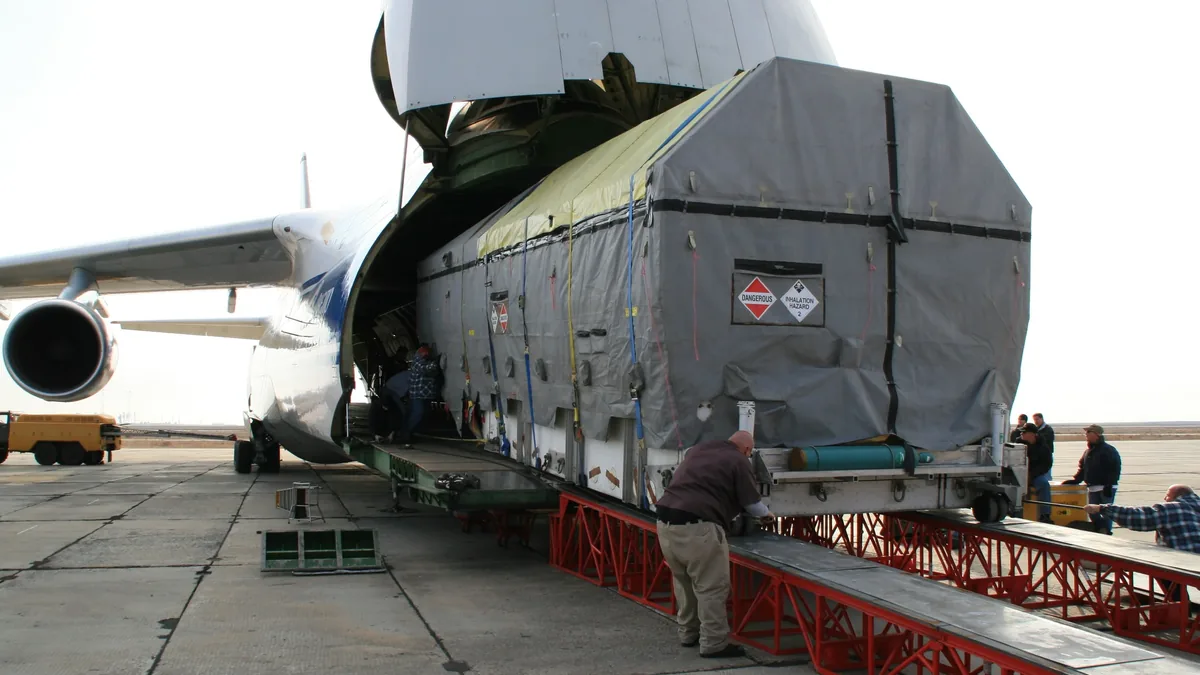
Air Cargo Demand
| Operating concept | Management of airline and shipper requirements for freight capacity |
|---|---|
| Primary units | Freight Tonne Kilometres (FTK) |
| Key drivers | Global trade volumes, industrial production indices, perishable goods cycles |
| Timeframe of forecasting | Typically seasonal to long-term (3-6 months) |
| Spatial granularity | Major trade lanes and regions |
| Data sources | Airline cargo load factors, airport throughput statistics, customs declarations |
| Original use | Inform airline fleet planning, route scheduling, and cargo pricing |
Origin and history
The systematic analysis and forecasting of air cargo demand emerged as a distinct discipline in the mid-20th century, following the commercial expansion of air freight after World War II. Its development is intrinsically linked to the growth of globalized trade and the advent of wide-body aircraft capable of carrying significant palletized and containerized loads. The practice originated within the commercial aviation sector, primarily driven by airlines, aircraft manufacturers, and later specialized freight carriers seeking to optimize their networks and fleet planning. Key methodologies were developed in North America and Europe, where major cargo hubs and integrators like FedEx and UPS established sophisticated demand modeling systems. The field evolved from basic trend analysis to incorporate complex econometric models that account for global trade flows, industrial production indices, and commodity prices. The rise of express parcel services in the late 20th century further refined demand forecasting techniques to include e-commerce growth and time-sensitive logistics.
What it is for
Air cargo demand analysis serves to quantify and predict the volume and type of freight that will require air transportation between global markets over specific timeframes. Its primary purpose is to inform strategic decisions within the aviation ecosystem, enabling efficient resource allocation and infrastructure planning. Airlines and integrators use these forecasts to determine fleet acquisition, retirement, and conversion strategies, such as deciding between dedicated freighters and passenger aircraft belly capacity. Airport authorities rely on demand projections to justify investments in cargo terminals, apron space, and ground handling equipment. Aircraft manufacturers utilize long-term demand forecasts to guide the development and marketing of new freighter aircraft and convertible models. Regulatory bodies and industry associations also use aggregated demand data to anticipate infrastructure needs and plan for airspace and airway capacity. Ultimately, it connects macroeconomic trends and trade patterns to the operational and financial planning of all entities involved in the air cargo supply chain.
Overview
Air cargo demand is not a single metric but a multi-dimensional analysis encompassing weight, volume, route specificity, commodity type, and service level requirements. It is fundamentally derived from the need to move high-value, time-sensitive, or perishable goods across long distances faster than sea or land transport allows. The analysis differentiates between general cargo, express parcels, and specialized freight like pharmaceuticals or live animals, each with distinct demand drivers and operational implications. Demand is measured in key industry metrics such as freight tonne-kilometers (FTKs), which combine weight and distance traveled, providing a standard unit for comparison. It is inherently volatile, more susceptible to global economic cycles, geopolitical events, and sudden supply chain disruptions than passenger demand. The system of forecasting integrates data from trade statistics, airport cargo traffic reports, airline financial disclosures, and economic indicators to build models that project future needs.
What to know
Understanding air cargo demand requires knowledge of its key drivers, which include global industrial production, world trade volumes, inventory cycles, and the unit value of traded goods. It is crucial to recognize that cargo demand is largely a derived demand, stemming from the needs of other industries like manufacturing, retail, and healthcare, rather than being an end in itself. The significant seasonality of demand, with peaks around holidays, product launches, and specific agricultural harvests, creates persistent challenges for capacity management. Yield, or the revenue earned per unit of cargo, is as critical a variable as volume, as the mix of high-yield and low-yield freight directly impacts carrier profitability. The role of passenger airline belly hold capacity cannot be overlooked, as it constitutes a major portion of total global air cargo capacity and directly competes with dedicated freighters on many routes. Finally, the structural shift towards e-commerce and the expectation of faster delivery times continue to reshape demand patterns, favoring integrator networks and certain airport hubs over others.
Common questions
A common question is why air cargo demand is considered more volatile than passenger demand, which is primarily due to its direct and immediate correlation with business inventory strategies and global trade health. Many ask how demand forecasts account for unforeseen events like pandemics or trade wars, to which the answer is that while such shocks are difficult to predict, models incorporate sensitivity analyses to stress-test scenarios. A frequent inquiry concerns the main difference between cargo demand for integrators like FedEx and traditional combination carriers, which lies in the former's focus on time-definite parcel traffic versus the latter's mix of general cargo and belly hold capacity. People often question which world regions generate the most demand, with the Asia-Pacific trade lanes, particularly to North America and Europe, consistently being the largest and most influential. Another typical question is about the impact of high fuel prices on demand, which can suppress volume but also can shift some traffic to sea freight, depending on the commodity's value density. Finally, there is regular interest in how digitalization affects demand, with platforms providing greater shipment visibility and data transparency, enabling more granular and real-time demand sensing.
Pros and cons
A significant advantage of sophisticated air cargo demand analysis is its ability to guide multi-billion dollar investments in aircraft and infrastructure with reduced risk, allowing for more efficient capital deployment across the industry. It enables airlines to balance their networks by identifying profitable cargo routes that may supplement weaker passenger demand, improving overall revenue resilience. However, a major con is the system's inherent vulnerability to model inaccuracies stemming from "black swan" events, such as global financial crises or sudden border closures, which can render long-term forecasts obsolete and lead to severe overcapacity or shortages. A common mistake is over-reliance on historical trend extrapolation without adequately weighting emerging disruptive factors, like near-shoring manufacturing or environmental regulations shifting trade patterns. Carriers and airports that commit heavily to infrastructure based on peak or inflated demand projections often regret the choice during inevitable downturns, facing underutilized assets and financial strain. Furthermore, the fragmentation of data sources and the lack of standardized, real-time shipment data across the globe remains a persistent weakness, limiting forecast precision and creating information asymmetries between different players in the supply chain.
Who it suits
This system of demand analysis is essential for the strategic planning departments of airlines, aircraft lessors, and manufacturers who must make long-term fleet decisions with lead times of several years. It suits airport operators and aviation authorities responsible for planning cargo terminal expansions, runway enhancements, and ground access infrastructure to accommodate projected growth. Financial analysts and investors specializing in the transportation and logistics sector rely on these forecasts to evaluate company performance and market potential. It is also critical for national trade and industry ministries formulating policies to enhance their country's competitiveness in global logistics networks. However, it is less directly useful for operational staff such as cargo handlers or flight crews, whose focus is on the immediate execution rather than long-term trends. The most effective users combine quantitative model outputs with deep qualitative market knowledge, understanding that the numbers provide a framework, not an infallible prediction.
Latest Air Cargo Demand news
Latest reporting

BermudAir Leases Embraer E190F for Cargo Expansion
BermudAir has leased an Embraer E190F freighter, marking its entry into dedicated cargo operations and the first deployment of this aircraft type in...

Etihad Targets Strongest Routes With A380 And 777 Fleet
Etihad Airways is deploying its largest widebody aircraft, including the Airbus A380, on specific routes with the strongest passenger demand for...

Tarmac Aerosave to Teardown Over 10 A320neo and 737 MAX Jets
Tarmac Aerosave will dismantle more than ten Airbus A320neo and Boeing 737 MAX aircraft this year for parts supplier AerFin, highlighting strong...

Trans Air Cargo DC-8 freighter crashes in Kinshasa
A rare DC-8-73CF freighter overran the runway at Kinshasa's N'Djili International Airport on September 8, 2026, collapsing its nose gear.

NTSB Begins Investigation into Fatal Amazon Prime Air Crash
The NTSB has launched its investigation into the fatal runway overrun of an Amazon Prime Air Boeing 767 cargo jet at Miami International Airport...
Egyptian Airlines Balance Fleet Growth with Seasonal Demand
As Egypt targets 30 million tourists annually by 2030, its airlines must balance permanent fleet growth with seasonal demand spikes, with industry...