Royal Navy conducts first carrier-based drone strikes
The Royal Navy has for the first time launched one-way strike drones from an aircraft carrier, with four Nyan Maritime drones successfully hitting targets during North Atlantic trials from HMS Queen Elizabeth.
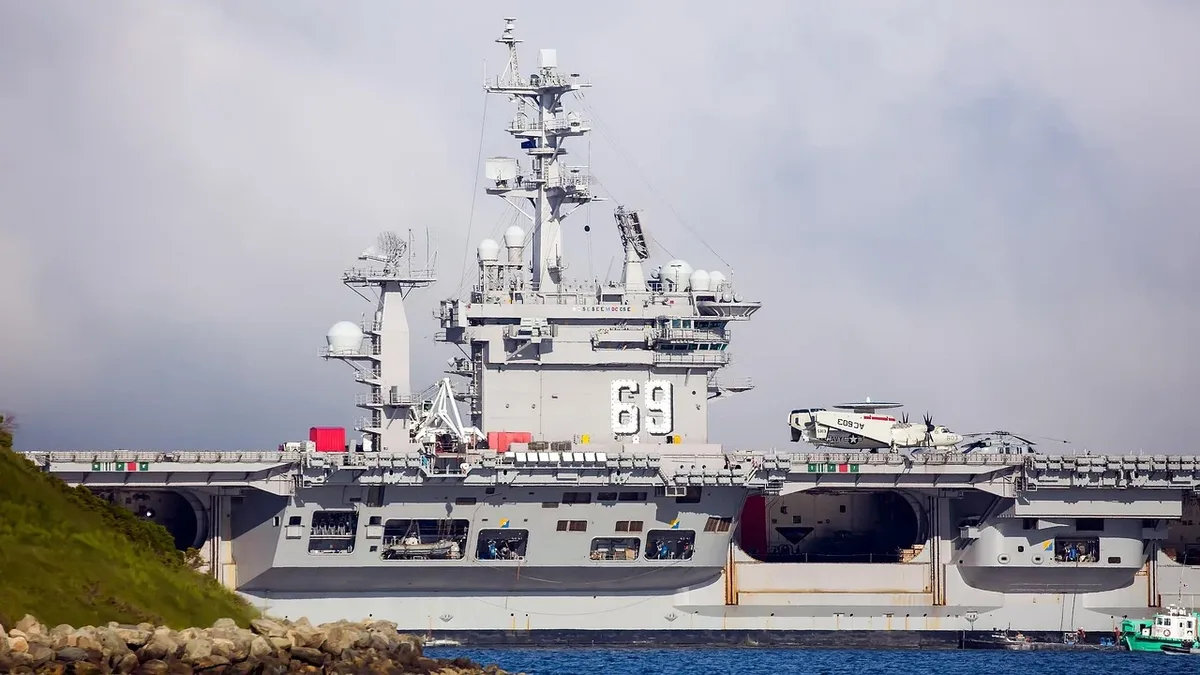
The Royal Navy launched four British-made Nyan Maritime one-way strike drones from HMS Queen Elizabeth for the first time in mid-October 2026. The launches, conducted during Exercise Neptune Reach B, saw all four aircraft successfully reach and hit their designated strike points, according to manufacturer BAE Systems.
These landmark North Atlantic trials demonstrated how autonomous strike systems could operate alongside crewed F-35B stealth jets. The flights from the carrier's deck mark a key step toward the Navy's planned hybrid carrier air wing, which aims to combine crewed and uncrewed aircraft to increase reach and lethality. BAE Systems said: "all four Nyans reached their designated strike points during Exercise Neptune Reach B".
The carrier flights followed the drone's first launch at sea from the experimentation ship XV Patrick Blackett earlier in the year during Exercise Neptune Reach A. That earlier trial involved personnel from 26 Regiment Royal Artillery and 744 Naval Air Squadron using a deck-mounted launcher while the vessel was underway.
AR5 drone operations from the carrier
In a separate but concurrent demonstration, the Tekever AR5 fixed-wing drone conducted the first-ever fixed-wing drone operations from a Royal Navy aircraft carrier. The AR5 flew for approximately 90 minutes from its base in Portugal to reach HMS Queen Elizabeth during the Heavy Lift Challenge 3 event.
After reaching the carrier, the AR5 completed two landings and two takeoffs from its flight deck before making a two-hour return flight to Portugal. The trials explored potential roles for the AR5 in logistics and intelligence, surveillance, target acquisition and reconnaissance (ISTAR) missions. The Royal Navy states the AR5 has a seven-metre wingspan and can carry an 80kg payload.
| Specification | AR5 Drone | Nyan Maritime Drone |
|---|---|---|
| Wingspan | 7 metres | 2.9 metres |
| Payload Capacity | Up to 80 kg | Flexible payload bay |
| Mission Type | Logistics, ISTAR | One-way precision strike |
Project Vantage and the hybrid carrier air wing
The Nyan and AR5 demonstrations formed part of Project Vantage, a cross-service collaboration between the Royal Navy, British Army and Royal Air Force intended to accelerate testing of maritime strike drones. The Royal Navy sees these trials as critical steps toward a hybrid carrier air wing that combines uncrewed aircraft with crewed platforms like the F-35B fighter.
Lieutenant Commander David Burton, trials sponsor for Navy Capability, said the trials give evidence and confidence to decide how uncrewed systems can work alongside crewed aircraft. Conducting these activities from HMS Queen Elizabeth allows us to explore how uncrewed strike drones might operate alongside other crewed and uncrewed capabilities within a maritime task group, said Burton. The goal is to increase operational choice while reducing the need to expose personnel to high-risk missions.
The Nyan One-Way Effector, developed by BAE Systems subsidiary Callen-Lenz, is a compact, jet-powered aircraft designed to deliver precision strikes and expend itself during its mission. Callen-Lenz chief executive Matt Foster stated more than 1,000 Nyan aircraft had been produced by July 2026.
Investment and future programme
These developments are linked to the Defence Investment Plan published on June 30, 2026, which commits more than £5 billion to autonomous systems by 2030. This represents the largest ever drone investment in UK Defence. The plan includes almost £250 million for Project Pantheon, an initiative to develop the hybrid carrier air wing and test jet-powered drones alongside the F-35B force.
At least £210 million is earmarked separately for low-cost, long-range one-way attack drones deployable across the Royal Navy, British Army and Royal Air Force. Defence Secretary Wes Streeting stated the threat environment is fundamentally different from recent decades and that innovation speed is a major determinant of military power. He said the investment strengthens warfighting readiness and therefore deterrence.
In a related procurement, the UK Ministry of Defence selected the Tekever AR5 to replace the British Army's Watchkeeper drones under Project Corvus, awarding a contract worth up to £400 million in September 2026. Tekever says AR5 manufacturing will be centred at its Swindon facility, supported by a consortium of UK SME partners.
The Royal Navy will continue trials of jet-powered drones alongside the F-35B force as part of Project Pantheon to inform the development of the hybrid carrier air wing.